
Sponsored byMixinflow
AI ModelAI Research & KnowledgeAI BusinessApproved
API-DNA icon

API-DNA

API-DNA is a free API fingerprint verification engine designed to detect fake

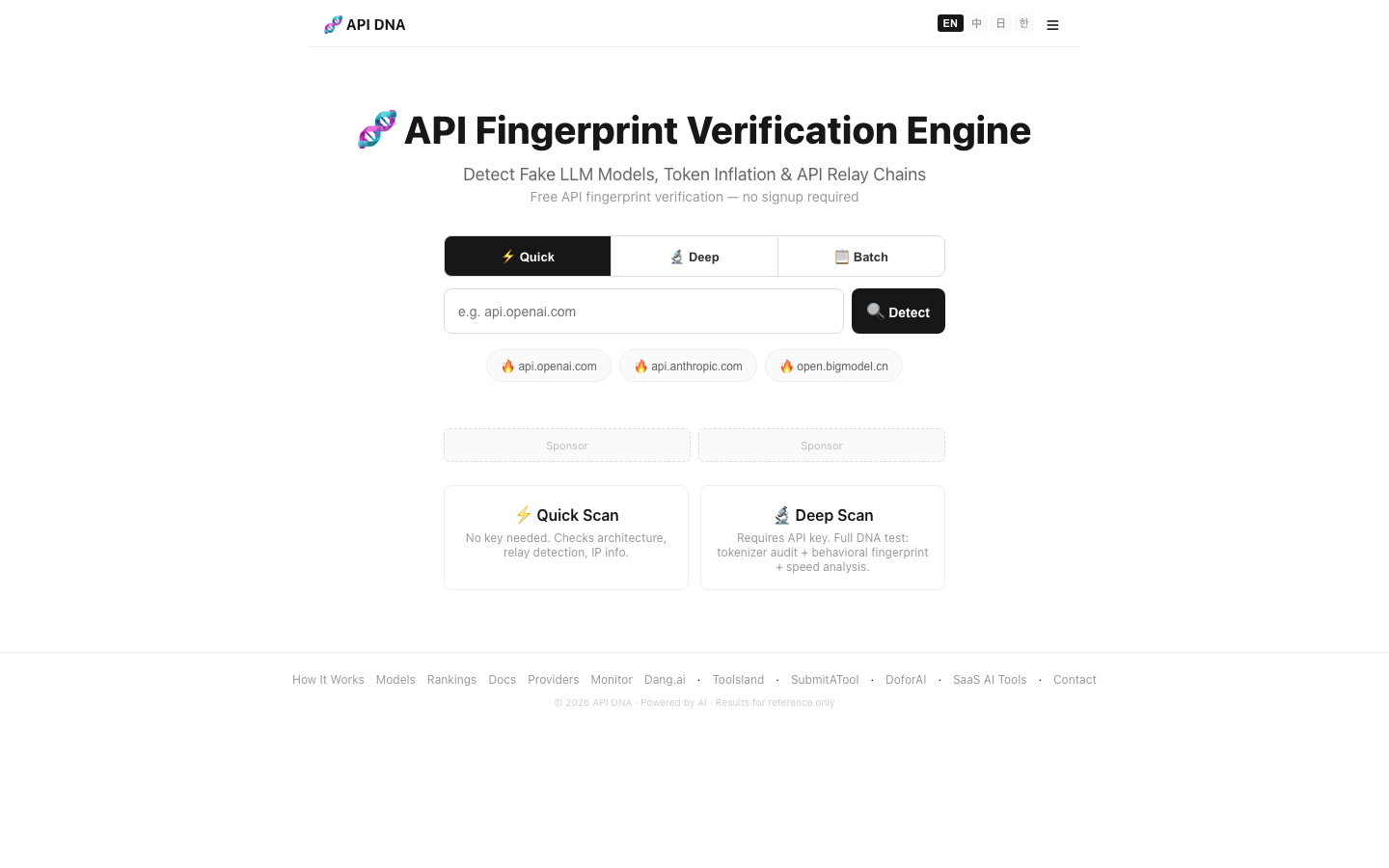
API-DNA is a free API fingerprint verification engine designed to detect fake Large Language Models (LLMs), token inflation, and API relay chains. It provides a quick scan without requiring an API key, analyzing architecture, relay detection, and IP information. For a more in-depth analysis, including tokenizer audits, behavioral fingerprinting, and speed analysis, a deep scan is available with an API key. API-DNA supports over 80 models, offering a valuable tool for understanding and verifying the authenticity of API interactions.

API-DNA screenshot
Try API-DNA

Website: api-dna.com

What is API-DNA?

API-DNA is a free API fingerprint verification engine designed to detect fake Large Language Models (LLMs), token inflation, and API relay chains. It provides a quick scan without requiring an API key, analyzing architecture, relay detection, and IP information. For a more in-depth analysis, including tokenizer audits, behavioral fingerprinting, and speed analysis, a deep scan is available with an API key. API-DNA supports over 80 models, offering a valuable tool for understanding and verifying the authenticity of API interactions.

At a Glance

Pricing
Not specified
Status
Approved
Platform
Web
Category
AI Model, AI Research & Knowledge, AI Business
Tags
ai-security, api-verification, fingerprinting, llm-detection, model-analysis, token-inflation

Why Choose API-DNA

Quick Scan

Perform a rapid verification of API architecture, detect relay usage, and gather IP information without the need for an API key or signup. API-DNA is a free API fingerprint verification engine designed to detect fake Large Language Models (LLMs), token inflation, and API relay chains. It provides a quick.

Deep Scan

Conduct a comprehensive analysis by providing an API key for a full DNA test, including tokenizer audits, behavioral fingerprinting, and speed analysis. API-DNA is a free API fingerprint verification engine designed to detect fake Large Language Models (LLMs), token inflation, and API relay chains. It provides a quick.

Model Support

API-DNA supports a wide range of over 80 different LLM models, ensuring broad applicability for various verification needs. API-DNA is a free API fingerprint verification engine designed to detect fake Large Language Models (LLMs), token inflation, and API relay chains. It provides a quick.

Fake LLM Detection

Identify and flag instances of fake or misrepresented LLM models attempting to pass as legitimate services. API-DNA is a free API fingerprint verification engine designed to detect fake Large Language Models (LLMs), token inflation, and API relay chains. It provides a quick.

Token Inflation Detection

Analyze API usage patterns to detect and alert users about potential token inflation tactics. API-DNA is a free API fingerprint verification engine designed to detect fake Large Language Models (LLMs), token inflation, and API relay chains. It provides a quick.

How to Use API-DNA

  1. 1

    Access API-DNA

    Navigate to the API-DNA website to begin the verification process.

  2. 2

    Choose Scan Type

    Select either a 'Quick Scan' for immediate insights or a 'Deep Scan' for a more thorough analysis.

  3. 3

    Perform Quick Scan

    For a quick scan, simply input the API endpoint and initiate the analysis without providing any keys.

  4. 4

    Perform Deep Scan

    For a deep scan, provide your API key when prompted to enable advanced features like tokenizer audits and behavioral fingerprinting.

  5. 5

    Review Results

    Examine the detailed report generated by API-DNA to understand the fingerprint verification of the LLM model.

Best For

  • Verifying new API providers

    Who: Developers and businesses integrating with third-party APIs · Ensure the legitimacy and performance characteristics of an API before committing to integration.

  • Detecting malicious API activity

    Who: Security analysts and platform administrators · Identify and mitigate risks associated with fake LLM models or API relay chains used for fraudulent purposes.

  • Auditing LLM model performance

    Who: AI researchers and model developers · Gain insights into model behavior, token usage, and speed to optimize performance and identify anomalies.

  • Preventing token overcharging

    Who: Cost-conscious users and procurement managers · Uncover instances of token inflation to avoid unexpected costs and ensure fair billing.

  • Benchmarking API services

    Who: Technical evaluators and comparison platforms · Use API-DNA's fingerprinting to objectively compare different API offerings.

Frequently Asked Questions About API-DNA

What is API fingerprint verification?

API fingerprint verification is the process of analyzing an API's characteristics, such as its architecture, response times, and tokenization behavior, to confirm its identity and detect potential misrepresentations or fraudulent activities.

Do I need an API key for API-DNA?

No, you do not need an API key for the 'Quick Scan' feature. However, a 'Deep Scan' requires an API key to perform more advanced analyses.

What types of fake models can API-DNA detect?

API-DNA is designed to detect fake LLM models, identify token inflation, and uncover API relay chains, helping to ensure you are interacting with genuine services.

How many models does API-DNA support?

API-DNA supports verification for over 80 different LLM models.

Is the 'Quick Scan' sufficient for security?

The 'Quick Scan' provides valuable initial insights into API architecture and relays. For comprehensive security and performance analysis, the 'Deep Scan' is recommended.

Can API-DNA guarantee the authenticity of an API?

API-DNA provides strong indicators and analysis to help you assess the authenticity and behavior of an API. The results are for reference and should be used in conjunction with other due diligence.

What information is included in a 'Deep Scan'?

A 'Deep Scan' includes a tokenizer audit, behavioral fingerprinting, and speed analysis, offering a more thorough examination of the API's characteristics.